GE VERNOVA | DISTRIBUTED BUS PROTECTION SYSTEM | MICOM P74X (P741/P742/P743)
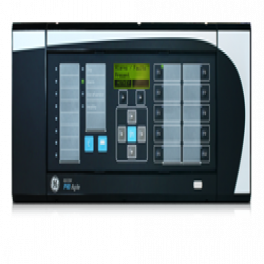
Part of the MiCOM P40 platform, the Agile P74x offers high performance, secure and sensitive protection for all types of busbar configurations at all voltage levels, accommodating up to 28 terminals in eight differential zones (three phase). Consisting of the Agile P741, P742 and P743 relays, the P74x platform is engineered to provide a centralized or distributed architecture with CT saturation detection, dynamic topology processing algorithms and a fast reset (less than 1 cycle) circuit breaker failure element.
Key benefits
- Tripping time is constant, less than 1 cycle and independent of the fault current, the substation topology and the number of feeders
- Suitable for application on solidly grounded, impedance grounded, Petersen coil grounded and isolated systems
- Free of charge software tools for easy scheme configuration and monitoring
- Connection between central and peripheral units is by redundant fiber, eliminating EMC, touch and step potential issues
- No internal batteries in GE Vernova-branded models – removes a maintenance item and eases air-freight logistics
- Advanced binary inputs comply with the harshest norms for surge withstand, plus the ESI 48-4 EB2 standard. Spurious wiring pickup is eliminated without the use of interposing relays, external resistors or time delays. Battery/wiring faults, switching noise, and induction from long parallel circuits are tolerated without mis-operation
Application
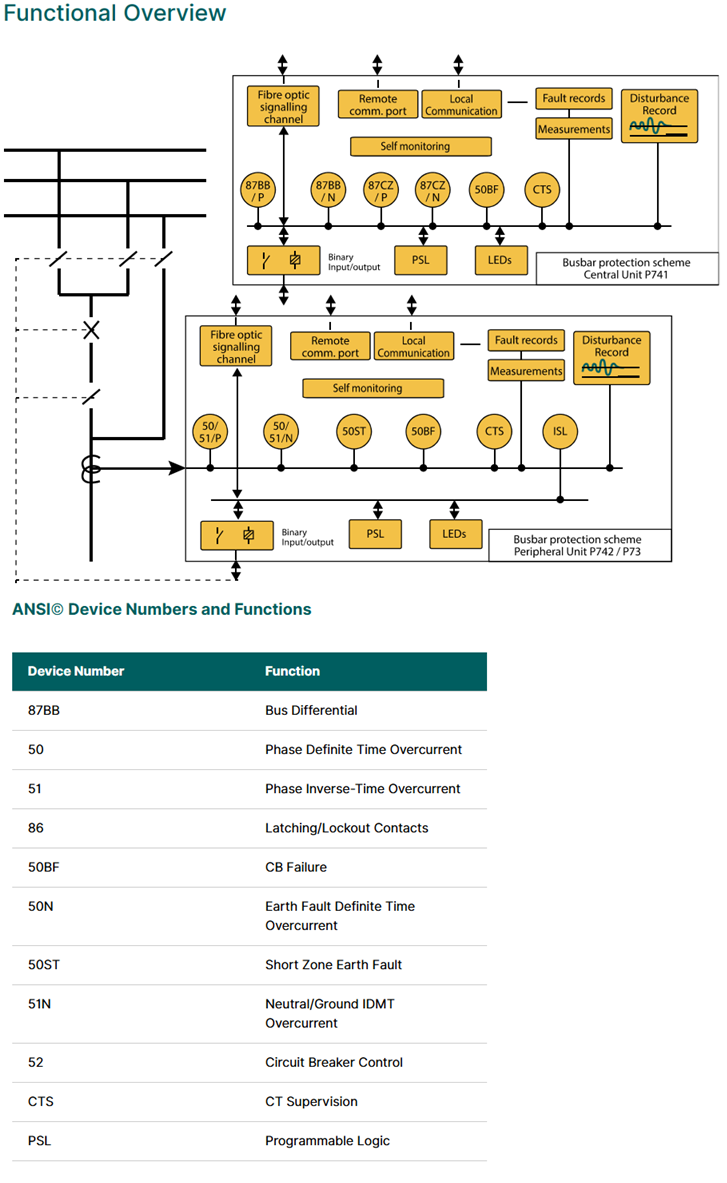
The MiCOM Agile P740 numerical busbar protection scheme is designed to protect a wide range of busbar configurations. The modular scheme utilises three relay types:- Central Unit (CU) - P741
- Peripheral Units (PU) - P742 / P743
These units interconnect using fibre optic cables and together with the topology configurator software allow application to all types of busbar configuration. The Central Unit co-ordinates the scheme, receiving signals from all the peripheral units associated with the protected busbars and acts on these signals. The CU then initiates a bus zone protection trip when necessary.
A single central unit can accommodate up to:
- 8 zones
- 28 peripheral units
The PUs acquire the analogue signals from the associated CT and the binary signals from the auxiliary contacts of the circuit breakers and isolators. The PUs also incorporate the main circuit-breaker failure logic together with additional protection functions (dead zone, overcurrent, etc.).
Where single pole breakers and transfer busbars are employed, the I/O requirements are high in comparison to those required for a single busbar application, so a P743 may be more suitable.
The P743 allows for increased opto inputs, function keys and an optional Ethernet board, and is particularly useful in double busbar applications.
Busbar Differential Protection
The primary protection element of the P740 applies phase segregated biased current differential protection. The technique is based on the numerical application of Kirchoff's law for the selective detection and ultra high-speed isolation of a faulted section of the busbar.The analysis is carried out in the Central Unit (CU) which communicates with the Peripheral Units (PU) to gather current information from individual circuits and to implement the tripping of circuits as required. This reliable, high-speed communication is achieved via a direct optical connection at 2.5 Mbps.
To ensure the adaptability of the relay to any type of busbar configuration, the P740 is built with a universal topology processing algorithm. This algorithm determines the optimum tripping zone based on the current status of the plant isolators and circuit-breakers.
The P740 employs biased differential algorithms, where the differential current is compared with a bias current. This characteristic ensures the stability of the protection for external faults, even with differing CT tolerances and errors, which could otherwise lead to spurious operation.
To increase the security of the differential protection, the biased differential element is supervised by a biased global check zone element. This ensures stability, even for any erroneous state indication from the auxiliary contact of plant isolators and circuit-breakers.
Local and Remote Communications
Two communications ports are available as standard: a rear port providing remote communications and a front USB port providing local communications. As an option, an Ethernet board can be added in the P741 and P743 to use the IEC 61850-8.1 protocol.The front USB port is designed for use with MiCOM S1 Agile, which fully support functions within the relay by: providing the ability to program the settings offline, configure the programmable scheme logic, extract and view events, disturbance and fault records, view the measurement information dynamically and perform control functions (using Courier protocol).
The default remote communications protocol is Courier / RS 485 or K-bus and can be converted to IEC60870-5-103. An optional second rear Courier communications port is also available, which can be configured as RS232, RS485 or K-Bus.
IEC 61850 is available when the optional Ethernet port is ordered. IEC 61850 offers high-speed data exchange, peer to-peer communications, reporting, disturbance record extraction and time synchronization.
P740 series extends the IEC 61850-8-1station bus to include Parallel Redundancy Protocol (PRP), and High-availability Seamless Redundancy (HSR) which offers a vendor-interoperable solution to implement redundant communications. It has the advantage of taking zero time to recover from a failure, as parallel alternative paths are continually operative.